Talking to Families about Safe Sleep
What you say to parents and caregivers of infants does make a difference!
- Use a strength-based approach. This helps families feel valued, not judged.
- Ask for permission to share information and remember to be respectful and sensitive.
- Use open-ended questions to get the conversation going and to keep it honest.
Remember the goal is to reduce the risk by sharing information, answering questions and concerns, discussing resources, problem-solving, and offering support.
Open-Ended Questions
For conversations about safe sleep to be successful, parents need judgment-free conversations that encourage open and honest dialogue. Using open-ended question such as, what do you like about bed sharing? What makes it hard for you to put your baby on their back to sleep? By proactively avoiding yes or no answers, you can better understand parents’ and caregivers’ motivations and help to create solutions for each family that reduces the risk of death or injury for the infant.
Open-Ended Questions to Talk About Safe Sleep
- What have you heard about ways to keep your baby safe while they sleep?
- What worries or questions do you have about how and where your baby should sleep?
- What do others who will care for your baby know about safe sleep practices?
- What plans have you made for where your baby will sleep? (Or- Where does your baby sleep?)
- We recommend that you put your baby to sleep alone, on his or her back and in a crib. What do you think about these recommendations?
Strategies to Reduce Risk During Pregnancy & After Baby is Born
During Pregnancy
- Avoid smoke/vape.
- Do not smoke/vape or expose yourself to others’ smoke/vape while you are pregnant and after the baby is born.
- Keep your car and home smoke-free at all times.
- Do not drink alcohol or use drugs while pregnant or after the birth.
- Get regular prenatal care to reduce your risk of having a low birthweight or premature baby.
Preparing for Baby
- Have a crib, bassinet, or portable crib (pack ‘n play) with a firm mattress and fitted sheet.
- Keep pillows, quilts, comforters, bumper pads, stuffed toys and cords out of the crib. Remember bare is best! Decorate the room NOT the bed
- Make sure the baby’s room does not get too hot.
When Baby Comes Home
- Place your baby to sleep on his back for naps and at night. If your baby can roll from his back to his side or stomach on his own, he can be left that way.
- If your baby falls asleep in a car, stroller, swing, infant carrier or infant sling move her to a crib or bassinet as soon as possible.
- Breastfeed as long as you can. Studies show that breastfeeding reduces the risk of SIDS. Exclusive breastfeeding (no baby formula) is best, but any breast milk is better than none.
- Make sure your baby goes to all scheduled doctor visits and gets all recommended shots. Evidence suggests that immunizations may protect against SIDS.
- Offer a dry pacifier (without a string) at nap time and bedtime. This helps reduce the risk of SIDS. If breastfeeding, wait around 3-4 weeks (until breastfeeding is established) before offering a pacifier. If baby does not take a pacifier, do not force it.
- Don’t let your baby get too hot. Dress him in one layer. Use clothing designed to keep babies warm without the risk of it covering their heads. Blankets are not recommended but if you decide to use a blanket, make sure it is tucked into the crib mattress to keep it from becoming loose and covering your baby’s face. Use the “feet-to-foot” guidelines: Put the baby so his feet are near the foot of the crib. Place a lightweight blanket across the baby’s chest just under the arm pits. Tuck the blanket securely along the two sides and foot of the crib.
- Do not use home breathing or heart monitors to reduce the risk of SIDS. These can be helpful for babies with breathing or heart problems. They have not been found to reduce the risk of SIDS.
- Do not use products that claim to reduce the risk of SIDS. Wedges, positioners, special mattresses and specialized sleep surfaces have not been shown to reduce the risk of SIDS. Some infants have suffocated using these items.
Talking About Bed Sharing
Most sleep related infant deaths in North Carolina are associated with bed sharing. Many parents bed share for different reasons and it is best to find out why they are bed sharing to be better able to talk with them about how to reduce the risk. You can do this through non-judgmental communication that includes the use of open-ended questions. Some parents are intentional about their desire to bed share, others do so on accident due to exhaustion. By better understanding what is driving parents to bed share, the better able you will be to talk with them about strategies to reduce the risk for infant by this practice.
It is especially important to talk about the circumstances in which bed sharing is VERY dangerous:
- When the infant is younger than 4 months
- If the infant was born premature or had low birth weight
- If the bed-sharer uses tobacco or if the mother used tobacco during pregnancy
- If the bed-sharer has taken illicit drugs or medicine that causes drowsiness
- If the bed-sharer has consumed any alcohol
- If the bed-sharer is not the parent
- If there are multiple bed-sharers (including other children)
- If the sleep surface is soft, such as an old mattress, waterbed, or pillow-top mattress
- If the sleep surface is a couch, sofa, or recliner
- If there is soft bedding, such as pillows or blankets, present in the bed.
You can talk with parents about their infants’ level of risk when it comes to bed sharing. It is important that parents clearly understand why this practice can be dangerous for all infants but making it personal about their infants’ risk is important. Also, although there is no 100% safe way to bed share, there are ways to reduce risks. Consider using our level of risk survey to help parents better understand their infant’s individualized risk factors regarding bed sharing.
The following guidelines are for all parents, whether they plan to bed share or not:
- Feeding a baby at night in an adult bed is safer than on a couch or recliner, both of which are extremely dangerous
- If feeding in a bed, keep all blankets, sheets, comforters, and pillows, away from the baby to prevent overheating and/or accidental suffocation
Click HERE for information for parents about reducing the risks associated with bed sharing.
https://safesleepnc.org/parents-caregivers/bed-sharing-understanding-the-risks/
Click HERE to learn more about how to have conversations with parents about bed sharing.
https://www.nichq.org/insight/conversations-can-stop-sleep-related-infant-deaths
Many families have questions about bed sharing and breastfeeding. Click HERE to read more about how to engage parents on this topic.
https://www.nichq.org/insight/bedsharing-breastfeeding-and-babies-dying-conversation-worth-having
Talking About Safe Sleep with Caregivers, Babysitters, and Child Care
It is important that parents also are sure that anyone who cares for their baby follows safe sleep practices. A study found that while parents and licensed childcare providers are catching on about safe infant sleep practices, friends, relatives, and babysitters often do not know how to help prevent sleep-related infant death.
https://www.sciencedaily.com/releases/2018/04/180402105138.htm
Licensed NC Child Care Facilities
In North Carolina, licensed child care facilities are required to follow strict safe infant sleep practices. Click HERE to read more about these policies. It is North Carolina law and childcare licensing rules require that in childcare settings.
https://www.mombaby.org/wp-content/uploads/2019/09/NC-Child-Care-Health-and-Safety-Resource-Center-Safe-Sleep-Poster-Eng-Sp.pdf
- Licensed childcare providers are taking important steps to be informed about reducing the risk of SIDS and other sleep related infant deaths and are working to help your baby sleep safely. North Carolina has important legal and licensing requirements designed to reduce the risks of SIDS/ SUIDS in childcare settings.
- When considering a childcare provider ask if the childcare provider is ITS-SIDS certified and look for the ITS-SIDS symbol. Ask to see the provider’s “Safe Sleep” policy.
- You can read the Safe Sleep Rules for Caregivers to see how caregivers are helping keep babies safer while they sleep and the steps they are taking to keep SIDS from happening.
- North Carolina law and childcare licensing rules require that in childcare settings: Place babies, 12 months of age or younger, to sleep on their back. A waiver may apply under certain circumstances. Childcare providers must have a written safe sleep policy and must explain it to parents before the baby is enrolled. Providers must complete the Infant/Toddler Safe Sleep and SIDS Risk Reduction in Child Care (ITS-SIDS) training.
- Place babies, 12 months of age or younger, to sleep on their back. A waiver may apply under certain circumstances.
- Childcare providers must have a written safe sleep policy and must explain it to parents before the baby is enrolled.
- Providers must complete the Infant/Toddler Safe Sleep and SIDS Risk Reduction in Child Care (ITS-SIDS) training.
The North Carolina Child Care Health and Safety Resource Center offers a toll free number ( 1-800-367-2229 ) as well as an online form that parents and anyone working in the child health and child care communities can use for more information.
http://healthychildcare.unc.edu/
Tips for Talking about Safe Sleep with Babysitters and Caregivers
Encourage parents to talk with everyone that cares for their baby about safe sleep. Encourage them to ask the following questions:
- What sleeping arrangements they already use for infants in their care.
- Ask to see what they already have for sleeping arrangements or if you should provide your own.
- Ask them what they would do if your baby were to fall asleep in the car seat, in a swing, or in a bouncy seat.
- Ask them how they put babies to sleep (babies should only be placed on their backs–not their side or stomach).
- Ask about tummy time, and ask to see where tummy time takes place.
- Ask if they or anyone who comes to the childcare location smokes/vapes, or if your baby will ever be around anyone who smokes/vapes while in their care.
- Ask if they use blankets, stuffed animals, or bumper pads in the crib.
Encourage parents to share the following safe sleep information: - Always put baby to sleep on his or her back.
- Always put baby to sleep in a crib or bassinet with a firm and flat mattress.
- Remove all blankets and pillows from the crib.
- Remove any other objects that could be hazardous, including stuffed animals, toys, and bumpers.
- Do not sleep on the same surface (bed, couch, etc.) with baby.
- Do not smoke or vape around baby
Refer parents to learn more by going HERE for English and HERE for Spanish.
https://safesleepnc.org/parents-caregivers/telling-others-about-safe-infant-sleep/
Talking About Baby Boxes
The North Carolina Safe Sleep Advisory Committee recently created a statement about baby boxes for both community leaders and parents. Click HERE to read the statement.
https://www.mombaby.org/wp-content/uploads/2019/02/Baby-Boxes-statement-from-NC-safe-sleep-advisory-committee-2.22.19.pdf
Baby boxes are sturdy cardboard boxes with a firm mattress, a waterproof cover, and a fitted sheet that are intended to serve as a safe sleep area when a traditional and recommended sleep area, like a crib, is not available. A baby box may be a great alternative for many families that need a place for their infant to sleep when used safely.
The following are factors that you can discuss with families regarding the use of a baby box:
- Babies should only sleep in the box for the first 3-4 months of life (or until they can turn over). After 4 months or when they can turn over, you will need another safe sleep space for your baby, such as a crib or pack-n-play.
- Make sure the baby box, like all sleep spaces for infants, does not contain any fluffy bedding, pillows, blankets, stuffed animals, or extra padding.
- The box is designed to be placed on the floor. It should not be placed on a bed, dresser, table, couch, counter, or any other unstable or high surface.
Common Questions and Concerns Parents Have About Infant Sleep
Parents often have questions about safe sleep and the recommendations. Here are some examples of common questions and examples of how to answer those questions. Note how the answers encourage feedback from parents.
Q) How am I going to breastfeed if my baby doesn’t sleep with me?
A) That is great that you are breastfeeding! Can you tell me what you like about bed sharing for breastfeeding? (listen to the answer) I see, by bed sharing you are able to easily breastfeed. That makes sense and you are right having the baby nearby does help to promote and maintain breastfeeding. Unfortunately, bed sharing is related to high rates of infant death especially with infants less than 4 months like yours. Can I share with you some other ideas about how to breastfeed and be sure that your baby is sleeping safe?
One idea is to put your baby’s crib near your bed so that you can easily pick them up for feedings during the night and then return them to their crib for sleeping. What do you think about this idea?
If the parent is unwilling to change their practice of bed sharing, discuss what factors put infants at higher risk when bed sharing. Further, discuss how to reduce risk by making sure that baby always sleeps on their back, that there is no soft bedding near the baby (blankets, pillows, etc.), that the bed is pulled away from the wall, and that the mattress is firm (not a soft pillow top, water bed, or air mattress).
Q) I want to bed share with my baby because it makes me feel close to them, is that wrong?
A) I know you want to feel close to your baby because you love them, but it is much safer for your baby to sleep on their own sleep space. Can you tell me other ways you can feel close to your baby that doesn’t include sleeping with them in the same bed?
(let them share and acknowledge their desire to be close to their baby)
Sleeping with an adult or in an adult bed increases the risk of a baby dying because they can be accidentally suffocated from bedding or the parent. You can have your baby near you but keep them safe, by having them sleep on a separate surface near your bed.
Can I share with you some of the times that bed sharing can be the most risky? (share circumstances in which bed sharing is very dangerous like when the baby is 4 months or younger, if the baby was born preterm or of low birth weight, if the bed sharers smoke or use medications or substances that make them drowsy).
Although there is no 100% safe way to bed share, there are ways you can reduce the risk by making certain things safer. You can do this by by making sure there are no pillows near the baby or blankets, and that the bed is pulled away from the wall, and that the mattress is firm—not a soft pillow top, water bed, or air mattress. What are your feelings about this information?
Q) I sometimes fall asleep while caring for my baby—what should I do?
A. I understand that happens to many parents. Caring for a newborn is exhausting and I know you are doing your best. I am glad you asked me about this.
Can I share with you some ideas ?
Ask others to help you, such as your partner, parent, or adult, to move the baby back to her crib if they see that you have fallen asleep with the baby. Another idea is to set an alarm for yourself to wake up and move your baby back to their crib. We all get sleepy, but one really important thing is to not care for your baby on the couch or recliner because that is a very risky place to fall asleep with your baby. Another tip is to keep your bed area clear of all bulky bedding and pillows in case you accidentally do fall asleep. What do you think about these suggestions?
Q. Won’t my baby choke if he or she throws up while sleeping on his or her back?
A. Great question, a lot of parents wonder about this. Actually, no. Healthy babies naturally swallow or cough up fluids. It’s a reflex all people have to make sure the airway is always open. Infants are actually less likely to choke when placed on their backs. When your baby is on their stomach, anything spit up can block the windpipe and cause choking or breathing problems. Even if your baby has reflux or GERD (gastroesophageal reflux disease) it is still safest for them to sleep on their backs. What do you think about this? What other questions do you have about infant sleep?
Q. What if my baby’s grandparents (or caregiver) want to place my baby to sleep on his/her stomach at naptime?
A. I am so glad you asked. Babies who usually sleep on their backs but who are then placed to sleep on their stomachs are at higher risk of Sudden Infant Death Syndrome (SIDS). So, it is important for everyone who cares for your baby to use the back sleep position for all sleep times—for naps and at night. How do you feel about talking to your parents or caregiver about this? What else can you tell me about how your infant is sleeping .
You can’t assume that others know about and follow safe sleep practices. So be sure to talk with everyone who cares for your baby about how and where your baby should sleep. What are your thoughts about doing that? (Continue to talk to parent about how to talk to caregivers about safe sleep)
Q. My baby sleeps better on his stomach. Why should I put them on their back?
A. A lot of babies do sleep better on their stomachs, but that is actually part of the problem. When babies sleep on their stomachs they are less reactive to noise, they can experience sudden decreases in blood pressure and heart rate control, and they can experience less movement and have longer periods of deep sleep. These things can put a baby at higher risk of SIDS. I know you want your baby to sleep well, but stomach sleeping is not safe. Putting your baby to sleep on their back really helps to lower the risk of SIDS. What do you think about that suggestion ?
Q. What does it mean to sleep in a safe sleep environment?
A. I am really glad you asked. I know there are a lot of things to know when it comes to taking care of a new baby. Can you tell me what you know about safe sleep and questions you have?
Thanks for sharing. A good way to think of a safe sleep environment is to remember A, B, C A is for alone. This means that a baby sleeps in alone (not with another person, or sibling, or pet). B is for back. This means the baby sleeps on their back for every sleep. C is for crib. This means they sleep in a crib (or bassinet or pack n play) without anything else in the crib but a tight fitted sheet on a mattress. No blankets, stuffed animals, pillows. This also means the baby doesn’t sleep on a couch or adult bed because they can be unsafe. I know that was a lot to hear. What other questions do you now have about your baby and sleep?
Q. I put my baby in their own crib, but I do use bumper pads to make it safer-why isn’t that ok?
A. It sounds like you want to make a safe and comfortable place for your baby to sleep. But what we know is that having extra stuff around the baby when they sleep is not safe. They can easily get covered by a blanket or stuffed animal and not be able to breathe. Bumper pads seem like a good idea and you see them everywhere, but babies are much safer without them because they can get caught up in them and this can cause them to suffocate or be strangulated. Crib slats (bars) should be narrow enough that a can of soda won’t fit through the space between them. Your infant is safer without the bumper pads. There is very little chance they would hurt their arms, legs, or head because of the crib bars, but they could get hurt because of the bumper pads.
What other questions do you have about your babies crib or sleeping?
Q. Why can’t my baby sleep in their sitting device (car seat, swing, bouncer, etc.) at night?
A. I am glad you asked me. What other places do you have available that your baby can sleep at night? I understand that sometimes we just want our baby to sleep wherever it works, but unfortunately, car seats and other sitting devices aren’t safe. It is best for infants to sleep alone on a firm flat crib or pack and play mattress.
Sitting devices, such as car seats, strollers, swings, and infant carriers are not recommended for routine sleep. Its also important to know that car seats and sitting devices are not stable on a crib mattress or other elevated surfaces. Infants sleep safest on a flat surface and infants should not be left unattended in car seats and similar products or with the straps unbuckled or partially buckled. Do you have another place that your baby could sleep? Can I share with you some other ideas to keep your baby safe when they sleep?
Key Terms and NC Data Trends
Despite a significant decrease in Sudden Infant Death Syndrome (SIDS), infant sleep-related mortality continues to affect many families in North Carolina. In North Carolina, SIDS and other sleep-related infant deaths are the leading cause of infant mortality in babies 1-12 months of age and the 3rd leading cause of death among all North Carolina infants. The majority of all of these deaths are associated with unsafe sleep environments.
Read below to learn more about SIDS and other sleep-related infant deaths and data trends specific to these deaths in North Carolina.
Key Terms
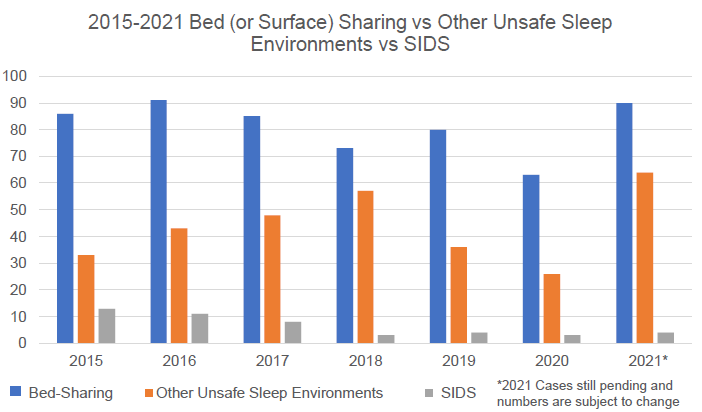
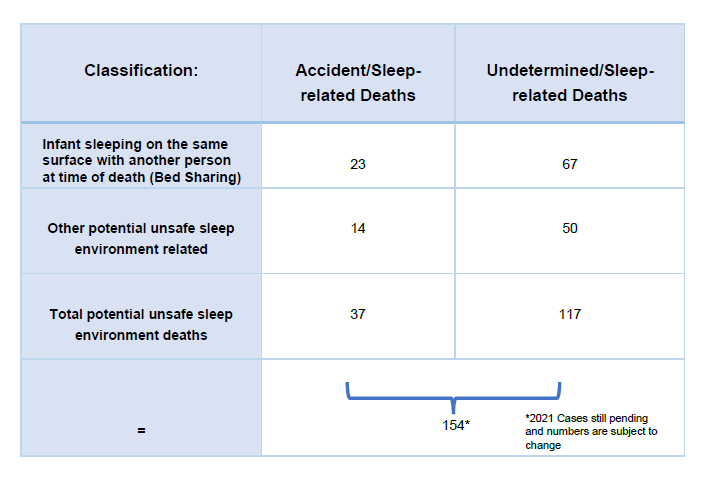
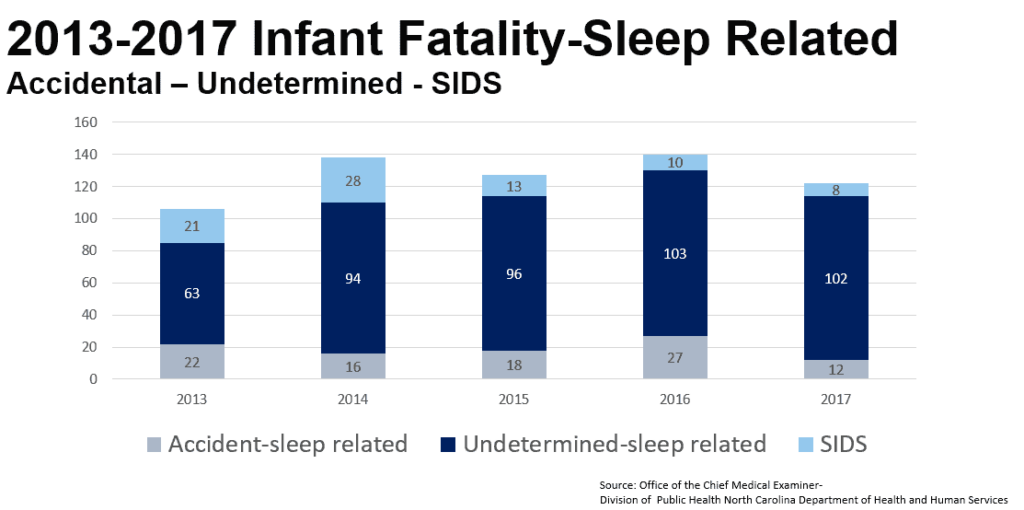
Sleep-related infant deaths are classified by the manner of death in three ways by the North Carolina Office of the Chief Medical Examiner: Accident, Undetermined, or Natural, which is when the death is classified as Sudden Infant Death Syndrome (SIDS). The large majority of deaths are associated with unsafe sleep environments. From 2013-2017, 641 North Carolina infants died suddenly unexpectedly while sleeping. Of these deaths, 88% occurred in an unsafe sleep environment (for example, blankets in bed, sleeping on an adult bed, etc.). And 70% of these deaths were associated with bed sharing (when an individual is sleeping on the same surface with an infant).
Sudden Unexpected Infant Death (SUID)
SUID is the death of an infant younger than 1 year of age that occurs suddenly and unexpectedly.
After a full investigation, SUIDs that occur during an unobserved sleep period may be diagnosed as one of the three types of SUID:
- Natural: Sudden Infant Death Syndrome (SIDS)
- Accidental: Accidental suffocation and strangulation in bed (ASSB)
- Undetermined/Unknown
These investigations are often very complicated and this makes it difficult to make a diagnosis. This is why so many deaths are classified as undetermined and unknown.
Sudden Infant Death Syndrome (SIDS)
Sudden Infant Death Syndrome (SIDS) is the sudden death of an infant younger than 1 year of age that cannot be explained even after a full investigation that includes a complete autopsy, examination of the death scene, and review of the clinical history. According to the Centers for Disease Control and Prevention, the overall rate of SIDS in the United States declined by more than 50% since 1990. However, better investigations of unexpected infant deaths and greater adoption of safe sleep practices may have contributed to fewer SIDS deaths.
Important to note: In North Carolina, if a sleep-related infant death was associated with an unsafe sleep environment, including bed sharing, it would not be classified as SIDS.
Bed sharing is when an infant sleeps on the same surface (bed, couch, chair, etc.) as another person (parent, sibling, caregiver, etc.).
SIDS is…
- Nationally is the leading cause of death in infants between 1 month to 1 year of age.
- A sudden and silent medical disorder that can happen to a seemingly healthy infant.
- Currently unpredictable and unpreventable, but the risk can be reduced.
- A diagnosis of exclusion, in which the cause of death can be determined only after ruling out other causes.
- A recognized medical disorder listed in the International Classification of Diseases, 10th Revision (ICD-10).
- An infant death that leaves unanswered questions.
SIDS is NOT…
- The cause of every sudden infant death.
- The same as suffocation or caused by suffocation.
- Caused by vaccines, immunizations, or shots.
- Contagious.
- The result of neglect or child abuse.
- Caused by cribs.
- Caused by vomiting or choking.
- Preventable, but there are ways to reduce the risk.
What causes SIDS:
Researchers are not 100% sure what causes SIDS, but research evidence suggests that some infants who die of SIDS are born with brain abnormalities or defects. These abnormalities are typically found within a network of nerve cells that rely on the neurotransmitter serotonin. The cells are located in part of the brainstem that probably controls breathing, heart rate, blood pressure, temperature, and waking from sleep.
Scientists believe that brain defects alone may not be enough to cause a SIDS death. Evidence suggests that other events, such as not getting enough oxygen, getting too much carbon dioxide, overheating, or having an infection, must also occur for an infant to die from SIDS. Normally, infants sense this inadequate air intake, and their brains trigger them to wake up or trigger their heartbeat or breathing patterns to change or compensate. However, in a baby with abnormalities in the brainstem, these protective mechanisms may be missing or slower to occur, so the child may succumb to SIDS. Such a scenario might explain why babies who sleep on their stomachs are more susceptible to SIDS.
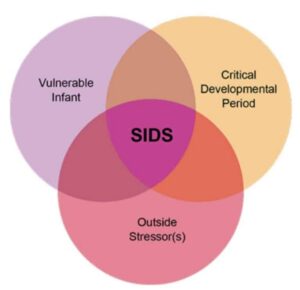
Researchers use the Triple-Risk Theory to explain this concept. According to the Triple-Risk Model, all three elements must be present for a sudden infant death to occur:
- The baby’s vulnerability is undetected.
- The infant is in a critical developmental period that can temporarily destabilize his or her systems.
- The infant is exposed to one or more outside stressors that he or she cannot overcome because of the first two factors.
Having only one of these features may not be enough to cause death from SIDS, but when all three combine, the likelihood of SIDS is high.
[Image on page: SIDS risk factors graphic]
Risk factors that put infants at higher risk for SIDS
- Side and stomach (prone) sleep position
- Prenatal and postnatal tobacco smoke, alcohol, and illicit drug exposure
- Soft or cushioned sleep surfaces (including sofas, couches, armchairs)
- Bed sharing
- Soft bedding (including pillows, blankets, sheepskins, bumper pads, and positioners)
- Head covering and overheating
- Preterm or low birth weight infants
- Not being breastfed
Many of the risk factors for SIDS are strikingly similar to those of other sleep-related infant deaths.
Accidental Suffocation and Strangulation in Bed (ASSB)
Accidental Suffocation and Strangulation in Bed (ASSB): One type of SUID, ASSB is a cause-of-death code used for vital statistics purposes. This code is used to identify infant deaths caused by suffocation or asphyxia (blockage of the infant’s airway) in a sleeping environment. The classification of Accidental Suffocation and Strangulation in Bed is used by the Office of the Chief Medical Examiner when circumstances definitively or strongly suggest the likelihood of asphyxiation.
These deaths are associated with unsafe sleeping environments for an infant. For example:
Suffocation by soft bedding: When soft bedding, a pillow, or a waterbed mattress blocks the infant’s airway.
Overlay: When another person shares the sleep surface with the infant and lays on or rolls on top of or against the infant while sleeping, blocking the infant’s airway.
Wedging or entrapment: When an infant gets trapped between two objects, such as a mattress and wall, bed frame, or furniture, blocking the infant’s airway.
Strangulation: When something presses on or wraps around the infant’s head and neck, blocking the airway.
Undetermined
This classification is given when it is not certain why the infant died. Other manners or causes of death cannot be ruled out, so definite cause cannot be determined. The large majority of deaths fall into the Undetermined classification.
Unsafe Sleep Environment
Most sleep-related infant deaths are associated with the infant sleeping in an unsafe sleep environment. It would be considered an unsafe sleep environment if the following was not practiced:
- Placing the baby on his or her back at all sleep times — including naps and at night.
- Using a firm sleep surface, such as a safety-approved mattress and crib.
- Keeping soft objects and loose bedding out of the baby’s sleep area.
- Sharing a room with baby, but not the same bed.
Bed Sharing
Bed sharing is when an infant sleeps on the same surface (bed, couch, chair, etc.) as another person (parent, sibling, caregiver, etc.). Bed sharing is considered an example of an unsafe sleep environment. This practice is also sometimes referred to as co-sleeping.
Infant Fatality Sleep Related Trends
Here is more specific information about these deaths from North Carolina’s Office of the Chief Medical Examiner. Read the complete report HERE. This information helps to explain the breakdown of the classification of deaths, the location, and other factors associated with these sleep related infant deaths.
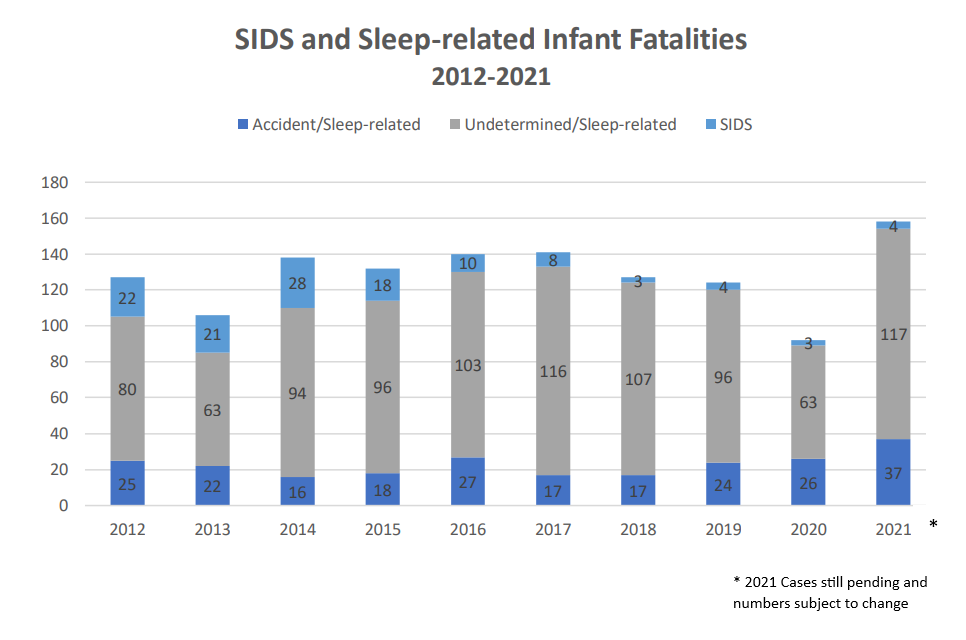
The majority of these deaths are associated specifically with unsafe sleep environment of bed sharing. As of 2011 in NC, cases where there is evidence of unsafe sleep would not be classified as SIDS.